Why Is Trust the Hardest Currency to Earn in Fintech?
Only 37% of consumers trust financial institutions with their data, and 72% would leave after a breach. Why trust is fintech's hardest currency — and what actually earns it.

A fintech app can ship a better feature in a sprint. It cannot ship trust on the same timeline. Trust in financial products is earned slowly, in small moments of reliability, and lost instantly, in a single bad headline.
How Much Do Consumers Actually Trust Financial Institutions With Their Data?
Only 37% of consumers trust financial institutions to protect their personal data. That is not a fringe skepticism. It means the majority of any bank or fintech's user base is, by default, not confident their information is safe, even before anything has gone wrong.
Source: CoinLaw, Financial Data Privacy Statistics
What Happens to Trust After a Breach?
94% of breached financial institutions reported a measurable loss of consumer trust and loyalty, and 72% of consumers say they would switch providers if they felt their data was not secure.
Source: CoinLaw, Financial Data Privacy Statistics
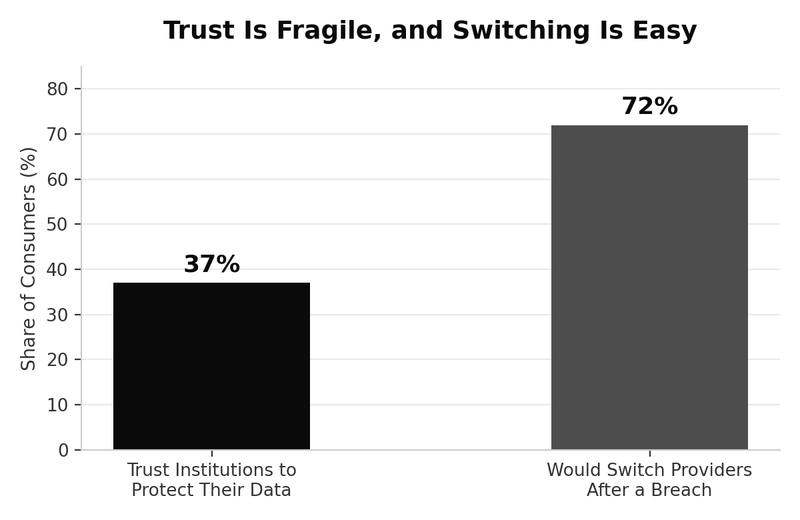
Baseline trust in data protection vs. willingness to leave after a breach
Source: Integris Banking Trust Outlook 2026
Why Do Banks Underestimate the Problem?
Part of the danger is a perception gap. 57% of banking customers believe their bank has never been breached, while breach notifications quietly happen behind the scenes more often than most customers realize. Institutions often read that silence as stability. It is closer to a delay before the trust actually breaks, and 66% of customers say they would consider switching banks once a serious breach becomes public, with nearly a quarter saying they would be very likely to leave.
Source: Integris Banking Trust Outlook 2026
Why Does This Matter More When You're a New, Unfamiliar Brand?
An established bank starts with a reservoir of accumulated trust built over decades, even if that trust turns out to be thinner than customers assume. A new financial brand has no reservoir at all. Every one of its early users is deciding, often for the first time, whether to hand a stranger their salary, their savings, and their financial identity.
That decision is harder for a Muslim consumer specifically, who is also evaluating whether the product's religious claims are genuine or simply marketing, which means the trust bar for a new entrant in this category is higher, not lower, than for a generic fintech app.
What Actually Builds Trust in Fintech?
The data points to a consistent answer: transparency before something goes wrong, not just damage control after. Consumers overwhelmingly say clear communication about data practices increases their confidence, and honesty during a crisis matters more than avoiding one entirely, since no institution avoids every incident forever. Building that transparency into the product from day one, rather than treating it as a crisis response plan, is the only version of trust that actually survives contact with a real problem.
//
early Access — UAE first
Be first. Be Able.
Join the waitlist now. UAE, Saudi Arabia, and Qatar launch first. Early users get priority onboarding, locked-in yield rates, and zero fees for the first year.