Why Do Remittance Fees Still Cost Muslim Expats So Much?
Gulf expats send $43 to $50 billion home from the UAE every year, yet the average transfer still costs 6.36% and banks charge nearly 15%. Why remittance fees remain stuck far above the UN's 3% target.
Every month, millions of Muslim expats across the Gulf send part of their salary home to family. It is one of the most routine financial acts in their lives, and it is also one of the most quietly expensive, with fees that have barely moved despite a decade of promises to fix them.
How Big Is the Remittance Market for Gulf Expats?
Expatriates make up roughly 88% of the UAE's population, the highest share of any country besides Vatican City, and they send home an estimated $43 to $50 billion every year, making the UAE the world's second largest source of outbound remittances after the United States.
Source: Ken Research, UAE Remittance Market Report
Half of that flows to just three countries, India, Pakistan, and the Philippines. The UAE alone sent $21.6 billion to India in 2023, making it India's second largest source of remittances globally after the US. This is not a niche financial habit. It is one of the largest and most consistent money movements in the region.
Source: World Bank Migration and Development Brief, via GetPureFi
How Much Does It Actually Cost to Send Money Home?
Sending $200 home costs 6.36% on average globally, according to the World Bank's Remittance Prices Worldwide report for Q3 2025. That is more than double the United Nations target of 3%, a goal the world committed to over a decade ago under Sustainable Development Goal 10.c.
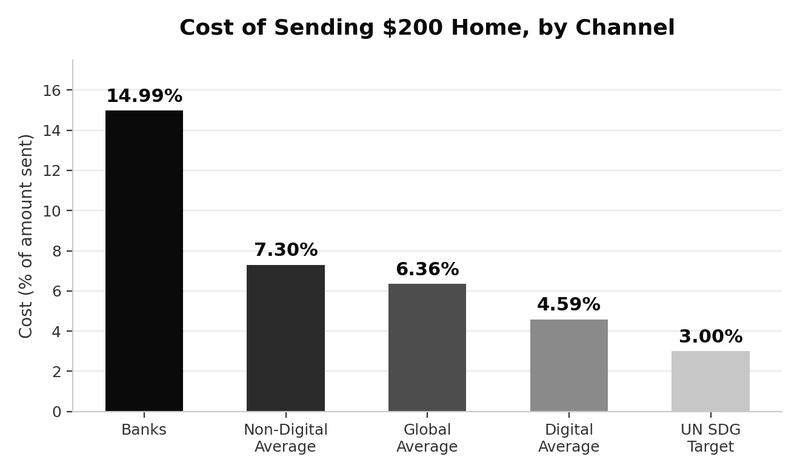
Average cost of sending $200 abroad, by channel, Q3 2025
Source: World Bank Remittance Prices Worldwide, Issue 54
Why Are Banks the Most Expensive Way to Send Remittances?
Banks remain the most expensive way to send money home, charging an average of 14.99%, nearly five times the UN's own target.
Source: World Bank Remittance Prices Worldwide, Issue 54
Banks charge more partly because of correspondent banking fees, currency conversion markups, and legacy infrastructure never built for high volume, low value transfers. Digital remittances, by contrast, average 4.59%, and the cheapest digital only providers get closer to 3.5%. The technology to send money cheaply already exists. It simply is not the default option most expats are offered.
Why Hasn't the World Hit Its Own Remittance Cost Target?
Costs have been falling slowly since 2009, when the global average sat at 9.67%, but progress has stalled well above the 3% target for years. The cost also is not evenly distributed. Sub Saharan Africa corridors average close to 8%, while South Asia, home to some of the largest Muslim expat corridors, averages closer to 5%. Even the better performing corridors remain well above what the UN considers fair.
Source: World Migration Report 2026, IOM
What Would Actually Lower the Cost for Muslim Expats?
The gap between the cheapest and most expensive way to send the same $200 is enormous, and most of that gap comes down to which rail the money travels on rather than any real cost of moving it. For a Gulf expat sending a fixed amount home every month, the difference between a 14.99% bank fee and a fair, transparent digital transfer adds up to real money kept in the family, not handed to an intermediary.
Able's global spending card is built around exactly this kind of user, someone whose financial life spans two countries and who deserves a fairer rate for something as routine as supporting the people back home.
//
early Access — UAE first
Be first. Be Able.
Join the waitlist now. UAE, Saudi Arabia, and Qatar launch first. Early users get priority onboarding, locked-in yield rates, and zero fees for the first year.