Why Do Muslim-Majority Countries Have Some of the Lowest Banking Rates in the World?
1.4 billion adults are unbanked, and 60% live in Muslim-majority countries — yet only 7% cite religion as the reason. The real drivers of the banking gap, and the evidence that better-designed products close it.
It is tempting to assume that low banking rates in Muslim-majority countries come down to religion alone, that interest is forbidden, so people simply opt out. The data tells a more complicated and, in some ways, more fixable story.
How Many Muslims Are Unbanked Worldwide?
Roughly 1.4 billion adults were unbanked worldwide in 2021, and about 60% of them live in predominantly Muslim countries. That is not a rounding error. It means a single religious and cultural bloc carries the majority of the world's financial exclusion problem.
Source: World Bank, via ResearchGate
Is Religion Really the Main Reason Muslims Avoid Banks?
Worldwide, just 7% of unbanked Muslims and unbanked non-Muslims alike cite religion as their reason for not having a bank account.
Source: World Bank Policy Research Working Paper 6642
The more common reasons look nothing like a values conflict. More than a fifth of unbanked adults in Muslim-majority countries said accounts were too expensive, that the nearest financial institution was too far away, or that they lacked the documentation to open one. Another 16% said they simply did not trust banks. Muslims are turning away from a system that was not built to reach them, not from banking itself.
Source: Brookings
How Big Is the Banking Gap Between Muslim and Non-Muslim Countries?
Even after controlling for GDP, Muslim-majority countries show a 29% lower rate of bank account ownership and a 24% lower rate of active bank borrowing than non-Muslim-majority countries.
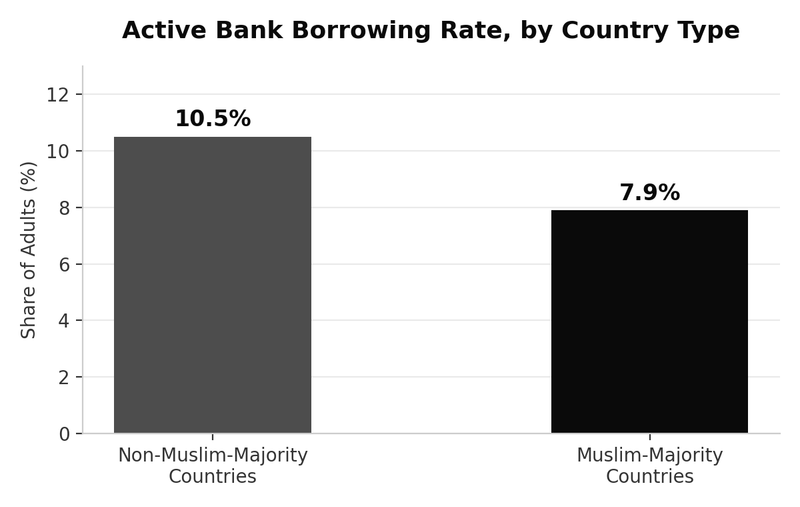
Share of adults actively borrowing from a bank, by country type
Source: World Bank, Islamic Finance and Financial Inclusion
Does Offering a Sharia Compliant Option Actually Change Behavior?
Yes, and the effect is measurable. In Jordan, simply offering a Sharia compliant loan option raised loan application rates from 18% to 22%, a meaningful jump driven by nothing more than removing the religious objection from the table. It suggests a large share of the unbanked are not opposed to formal finance. They are opposed to formal finance that never offered them a version they could actually use.
Source: Dean Karlan, Yale University, via Brookings
What Would It Take to Close the Gap?
Closing this gap is not primarily a theological project. It is a design and access project: cheaper accounts, closer digital access, simpler documentation, and products that are genuinely built around Islamic principles rather than conventional products with a certificate attached. The Islamic finance industry has grown 10 to 12% a year precisely because that combination works when someone builds it properly.
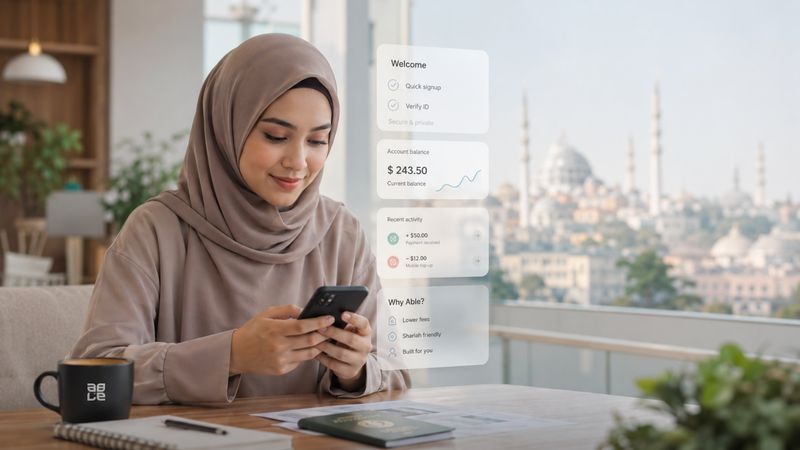
Able's global spending card is built on that same premise, that the fix for financial exclusion in Muslim communities is better access and better design, not a religious accommodation bolted onto a legacy system.
//
early Access — UAE first
Be first. Be Able.
Join the waitlist now. UAE, Saudi Arabia, and Qatar launch first. Early users get priority onboarding, locked-in yield rates, and zero fees for the first year.