Why Islamic Finance Is the Largest Blue Ocean Left in Banking
Two billion people, $6 trillion in assets against a conventional pool near $468 trillion, and double digit growth with a decade of runway. The numbers behind the widest unmet market in modern finance.
For most practicing Muslims, the financial products within reach quietly contradict the thing their faith asks them to organize their life around. Interest sits at the heart of conventional banking, and interest is exactly what Islamic teachings ask believers to keep out of their earnings.
Nearly two billion people carry that same friction every time they open a banking app. That gap between demand and supply is one of the widest left in modern finance, and it is why we built Able.
Strategists have a name for a market like this, the blue ocean. It is a space where demand goes largely unmet and competitors are thin on the ground, unlike the crowded waters where everyone fights over the same shrinking margin. Islamic finance is one of the clearest blue oceans in banking today, and the market size numbers make the case more forcefully than any pitch deck could.
Islamic Finance Market Size vs Conventional Banking
Close to two billion people, almost a quarter of everyone alive, follow a faith that places firm conditions on how wealth can be earned, lent, and grown. Global Islamic finance assets sat at roughly $6 trillion at the end of 2024. Set that figure beside the conventional financial system, now measured at around $468 trillion, and the imbalance reads like an open door.
A population this size is served by a system less than one seventieth the scale of the mainstream one. Demand of that magnitude paired with supply this thin does not stay unmet forever.
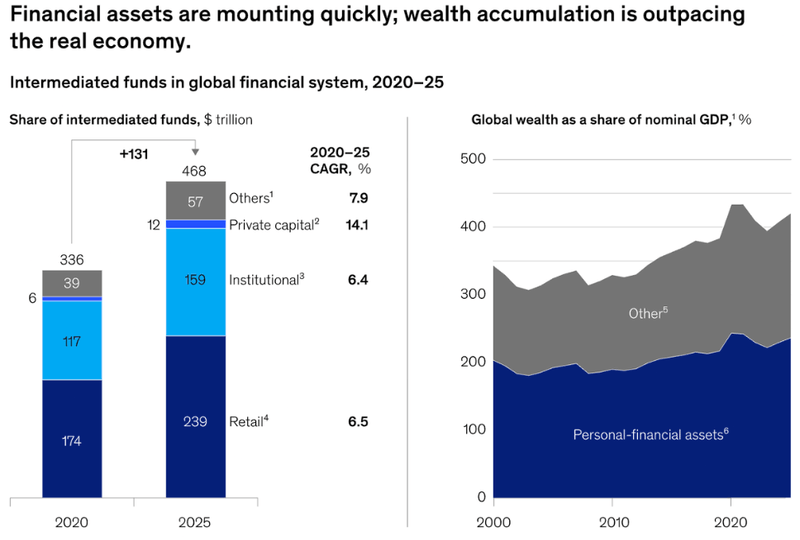
Source: McKinsey Global Banking Annual Review 2026
Why Islamic Finance Is Still a Young Industry
Modern Islamic finance is barely two generations old. An Egyptian savings experiment in Mit Ghamr opened its doors in 1963, and the first full fledged Islamic commercial bank followed in 1975. Set against conventional banking, which traces its lineage across several centuries, this is an industry that has only begun to stretch its legs.
Youth explains a great deal about the current landscape. Product design, distribution, and digital experience have had five decades to mature, versus the many generations conventional finance enjoyed. Anyone building a sharia compliant financial app today inherits an enormous canvas and very little of the legacy baggage that slows incumbents elsewhere.
A Concentrated Market Where Muslim Consumers Deserve More Choice
Around two thousand sharia compliant institutions and products serve that entire global population, a strikingly small catalogue for two billion prospective customers. Concentration runs deep at the top as well. Al Rajhi Bank, the world's largest Islamic bank with roughly $260 to $278 billion in assets, holds close to one twentieth of the whole industry on a single balance sheet.
If you found any mature consumer market with one brand commanding nearly five percent and a couple of thousand offerings covering a quarter of humanity, you would call it wide open. This is the texture of Islamic finance today, and it is precisely the texture that rewards builders who show up early with a halal financial app people actually want to use.
Islamic Finance Growth Statistics: Double Digit Growth With Plenty of Track Ahead
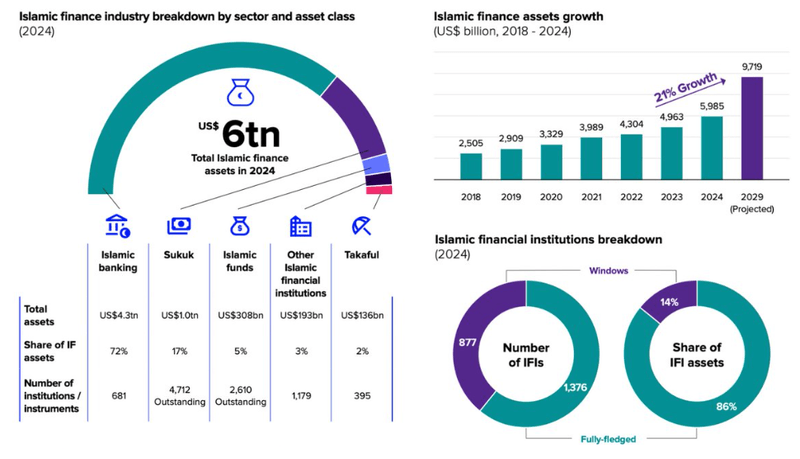
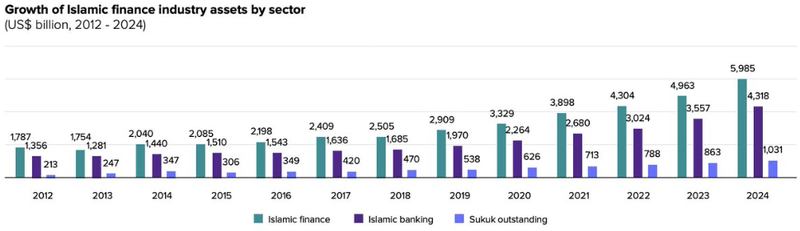
Assets have compounded at double digit rates for several years running. The pool is projected to reach $9.7 trillion by 2029, expanding near ten percent annually. Global sukuk issuance hit $264.8 billion in 2025, up from $234.9 billion a year earlier, and S&P Global expects it to push toward $280 billion in 2026. Gulf capital markets coverage tells a complementary story: structured, asset backed credit is arriving earlier and at greater scale across the region, and fintech is absorbing the overwhelming share of it.
Growth like this rarely comes from a single tailwind. Demographics push from below, since Muslim populations skew young and are entering their prime earning years. Regulation matures from above, as more markets write clear frameworks for sharia compliant products. Technology cuts across both, letting a well built app reach a customer in Jakarta, Lagos, or London at a fraction of the cost a branch network once required.
Building a Financial App for Practicing Muslims
We believe a modern financial super app can feel effortless and honor the rules Muslim users live by, without asking anyone to choose between the two. Compliance is the foundation, not a compromise. Value created through participation in the real economy, and shared honestly with the customer, is the original logic of Islamic finance. Modern software finally lets us deliver it at the speed and polish people expect from any app on their phone.
The Opportunity in Islamic Finance Is Measurable, and It Is Enormous
Two billion people and roughly $6 trillion in assets against a conventional pool near $468 trillion. Two thousand services where a mature market would hold hundreds of thousands. A single institution near five percent share, and double digit growth with a decade of runway acknowledged by the most conservative forecasters in the field.
We read these figures as one of the clearest invitations in modern finance to build something that serves people the way their faith and their standards both deserve. The ocean is blue, the water is deep, and there is room for boats far better than the ones sailing it today.
Able intends to build one of them.
//
early Access — UAE first
Be first. Be Able.
Join the waitlist now. UAE, Saudi Arabia, and Qatar launch first. Early users get priority onboarding, locked-in yield rates, and zero fees for the first year.