What Is Halal Banking, and How Is It Different From a Regular Bank?
Halal banking is a $3 trillion system with specific rules, not a marketing label. What actually makes a bank halal, which countries lead, and how to tell a genuine product from branding.

The phrase gets used loosely, sometimes as a marketing label, sometimes as shorthand for an entire parallel financial system. Halal banking is a specific thing with specific rules, and understanding what actually makes a bank halal explains a lot about why it looks and operates differently from the one most people grew up with.
What Makes a Bank Halal in the First Place?
A halal bank is built to avoid riba, interest, in every product it offers. Instead of lending money and charging interest on it, halal banks use structures based on profit and loss sharing, trade, and asset ownership, where the bank earns money by genuinely participating in an economic activity rather than charging a fee for the use of money itself. A Sharia board of qualified scholars reviews products to confirm they meet these standards, which is what separates a bank that is actually halal from one simply using the word.
How Big Is Halal Banking Globally?
Islamic banking assets now exceed $3 trillion globally, growing at 10% to 15% a year, consistently outpacing conventional banking growth in most of the markets where both operate side by side.
Source: HalalWallet, Islamic Finance Statistics 2026
Which Countries Actually Lead in Halal Banking?
Just 10 countries hold almost 95% of the world's Sharia compliant banking assets. Saudi Arabia and Iran each account for roughly 25% to 30% of the global total, followed by Malaysia at 12% and the UAE at 10%.
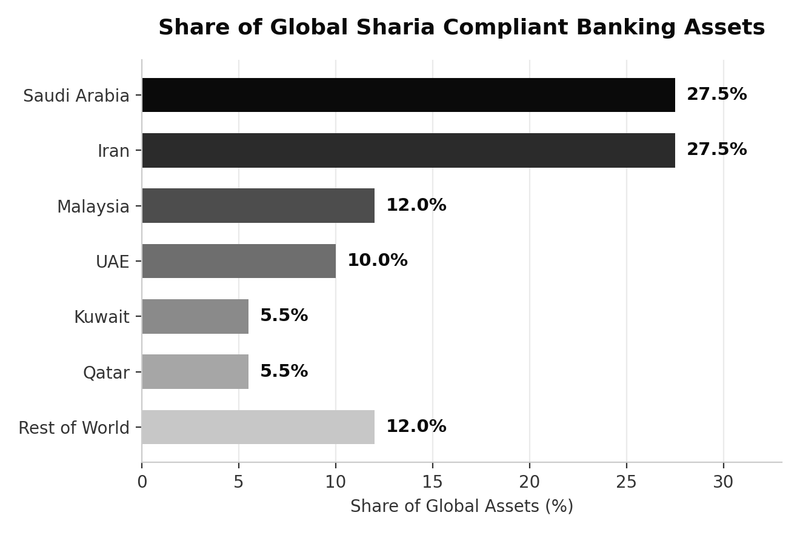
Share of global Sharia compliant banking assets, by country
Source: CoinLaw, Islamic Banking Statistics 2026
Are Halal Banks Actually More Stable Than Conventional Ones?
Saudi Islamic banks posted an average return on assets of 2.5% in 2024, well above the 1.5% average across the world's 100 largest Islamic banks, alongside strong capital positions and ample liquidity.
Source: The Asian Banker, Islamic Bank Rankings
The asset backed, risk sharing structure at the core of halal banking is often framed as a religious constraint. The performance numbers tell a different story: the same structure that keeps a bank compliant also tends to keep it disciplined, because it cannot simply lend against risk it does not genuinely hold or share.
What Should You Look For in a Genuinely Halal Banking Product?
Given how concentrated genuine expertise is in a handful of markets, a product built outside those countries deserves real scrutiny. The questions worth asking are simple: is there a named, qualified Sharia board reviewing the product, is the underlying structure actually profit and loss sharing or asset backed rather than a conventional loan with different paperwork, and is that structure explained clearly rather than assumed.
A halal label without those answers is marketing. A halal product built the way the concentration of expertise above suggests it should be is something else entirely, which is the standard Able is building toward from day one rather than retrofitting later.
//
early Access — UAE first
Be first. Be Able.
Join the waitlist now. UAE, Saudi Arabia, and Qatar launch first. Early users get priority onboarding, locked-in yield rates, and zero fees for the first year.