What Are Stablecoins, Explained Simply?
Stablecoins moved $33 trillion in a year and 232 million people hold them — yet most people can't define one. A plain-language explainer on digital dollars and what they're actually used for.

Stablecoins have quietly become one of the largest payment rails on the planet, and most people have still never used the word in a sentence. Here is what they actually are, and why the number attached to them is bigger than most people expect.
What Is a Stablecoin, in Plain Terms?
A stablecoin is a digital dollar. It is a type of cryptocurrency built to hold a steady value, almost always pegged one to one with the US dollar, instead of swinging up and down like Bitcoin or other crypto assets. The technology behind it is the same blockchain infrastructure that powers crypto generally, but the goal is the opposite of speculation: a stablecoin is supposed to be boring, predictable, and always worth roughly one dollar.
How Big Is the Stablecoin Market Right Now?
The total stablecoin market cap sits at roughly $308 to $315 billion as of mid to late 2026, up from $161.5 billion in mid-2024, nearly doubling in two years. Two issuers, Tether and USD Coin, account for more than 80% of all stablecoin value in circulation, and an estimated 232 million people now hold stablecoins in some form.
Source: CoinLaw, Stablecoin Market Cap Statistics 2026
What Are People Actually Using Stablecoins For?
The honest answer is that most stablecoin activity is still trading and moving funds between exchanges, not everyday payments. But the non-trading share is exactly the part relevant to someone who isn't a crypto trader at all.
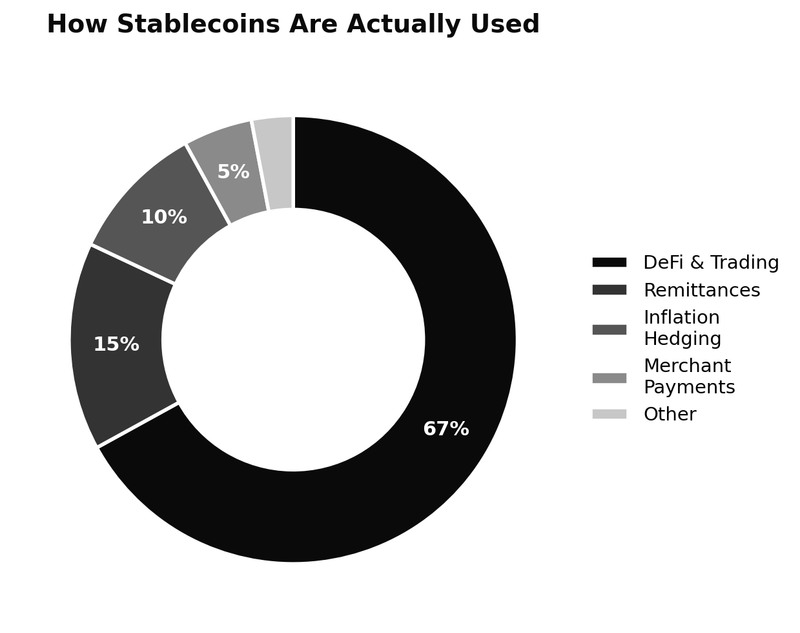
Breakdown of stablecoin usage by purpose
Source: CoinLaw, Stablecoin Statistics 2026
Remittances alone account for 15% of stablecoin usage, and merchant payments make up another 5%, which together represent tens of billions of dollars moving through stablecoins for the exact same reasons people currently use banks and money transfer apps, just faster and often cheaper.
Are Stablecoins Really Bigger Than Visa?
Stablecoin transaction volume hit $33 trillion in 2025, up 72% year over year, a throughput now rivaling major card networks.
Source: Stablecoin Insider, 2026 Market Growth Report
That number needs a caveat to be honest rather than impressive for its own sake. Of the tens of trillions in stablecoin transfers each year, only an estimated $350 to $550 billion represents genuine real economy payments, buying things, paying people, settling invoices. The rest is trading activity and funds moving between wallets and exchanges. Stablecoins are already huge as financial infrastructure. They are still early as an everyday payment method.
Source: Bank for International Settlements; BCG x Allium, via Reap
Why Should an Everyday User Care?
Even in businesses that have adopted them for practical use, the appeal is straightforward: 41% report meaningful cost savings, mostly on cross border payments, the exact pain point that makes conventional international transfers slow and expensive. For someone who already holds stablecoins, whether from freelance income, remittances, or simple curiosity, the real gap has always been turning that balance into something spendable in daily life without friction.
That is precisely the gap Able's global spending card is built to close, letting a stablecoin balance function like money you can actually use, not just an asset sitting in a wallet.
//
early Access — UAE first
Be first. Be Able.
Join the waitlist now. UAE, Saudi Arabia, and Qatar launch first. Early users get priority onboarding, locked-in yield rates, and zero fees for the first year.