What Does AI Native Finance Actually Mean for Muslim Consumers?
Half of consumers already use AI for money tasks weekly, yet only 18% would trust it to decide for them. What AI native finance means, and why it fits Muslim consumers' questions especially well.

Ask most people what they want from a finance app and the answer is rarely a dashboard full of charts. It is an honest answer to a simple question: how much did I spend on this, and can I afford that. AI native finance is the industry's attempt to actually deliver that, instead of asking users to work it out themselves.
What Does AI Native Finance Actually Mean?
AI native finance describes financial products built around AI from the ground up, rather than conventional banking software with a chatbot bolted on afterward. In practice, that means being able to ask a plain language question about your own money, how much you spent on food this month, whether a purchase fits your budget, what a fee actually cost you, and getting a direct answer instead of a spreadsheet to interpret yourself.
How Many People Already Use AI for Money Matters?
Adoption has moved fast. 61% of Americans have already tried at least one AI task tied to banking or finance, and that number climbs to roughly 80% among Gen Z and Millennials. Weekly use is already mainstream, with 49% of consumers using AI for financial tasks at least once a week.
Source: Success Knocks, AI Financial Tools Adoption 2026
Why Don't People Fully Trust AI With Their Finances Yet?
Only 18% of consumers say they would trust AI to make financial decisions independently, a number that has barely moved year over year even as everyday AI use has surged.
Source: TD 2026 AI Insights Report
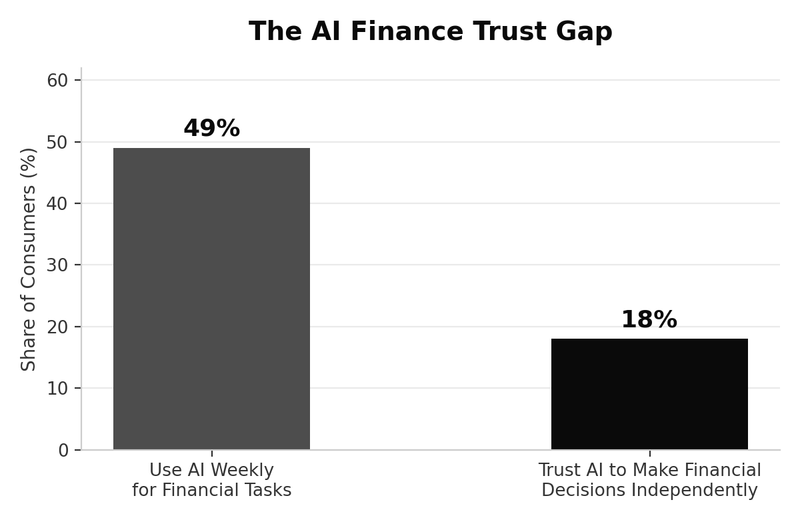
Weekly AI use for finance vs. trust in independent AI financial decisions
Source: MX 2026 Consumer Banking Trends; TD 2026 AI Insights Report
The gap between using AI for convenience and trusting it for judgment is the defining tension of this category right now. People want AI to explain their money in plain language. Far fewer want it deciding what to do with that money on their behalf, and that instinct is a reasonable one, not a barrier to design around.
Why Does This Matter More for Muslim Consumers?
Muslim consumers already carry an extra layer of financial questions that conventional apps were never built to answer: is this fee structured in a way that is actually permissible, does this purchase category align with how I want to spend, is this account genuinely compliant or just marketed that way. A plain language AI assistant is a natural fit for exactly this kind of question, turning what used to require research or a call to a scholar into an immediate, transparent answer inside the app someone already uses every day.
What Would Trustworthy AI Native Finance Look Like?
Based on where trust actually sits today, the winning version of AI native finance is not an autonomous advisor making decisions in the background. It is a transparent one, answering direct questions clearly, showing its reasoning, and leaving the actual decision with the user.
That is the version Able is building toward, an app where speaking to your money in plain language is the default experience, not a premium feature layered on top of a conventional one.
//
early Access — UAE first
Be first. Be Able.
Join the waitlist now. UAE, Saudi Arabia, and Qatar launch first. Early users get priority onboarding, locked-in yield rates, and zero fees for the first year.