Is Stock Trading Halal, and What Are the Rules?
Buying shares in permissible companies is broadly halal — the disputes are about how you trade. Where day trading, margin, options, and short selling each land, and why.

The question of whether stock trading is halal has a clearer answer than most people expect, once it's separated from the question of whether a particular trading style is halal. Buying and selling shares is not the issue. How the trade is structured is.
Is There a Minimum Holding Period Required in Islam?
Nothing in Islamic law fixes a minimum holding period for shares. Buying a halal stock in the morning and selling it in the afternoon is, in itself, an ordinary sale.
Source: HalalScreener, Is Day Trading Stocks Halal
That single point resolves a lot of confusion. Egypt's Dar al-Ifta has ruled that stock trading with genuine trading intent is lawful, and Ayatollah Sistani's office has stated it finds no objection to stock market investing itself. The permissibility question is not about speed. It is about structure.
What Actually Makes a Trade Impermissible?
Four specific practices, not trading itself, are where the consensus against permissibility is strongest: margin trading, short selling, options and other derivatives, and forex positions held overnight with a swap charge attached.
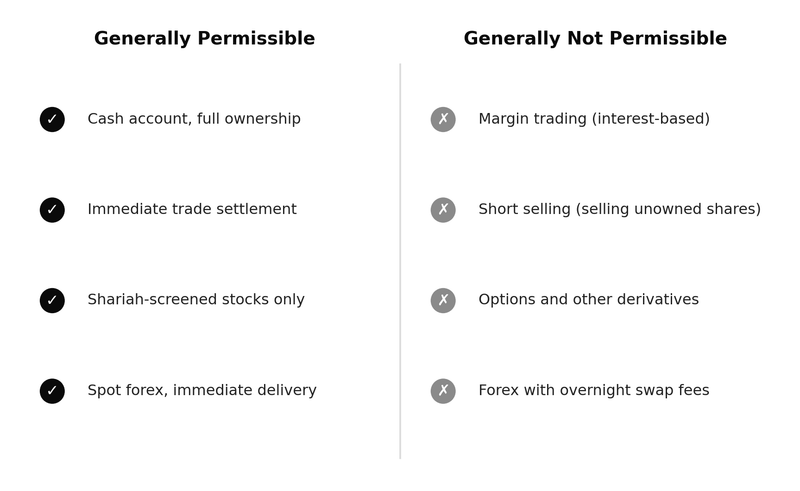
Trading practices generally considered permissible vs. not permissible
Source: HalalScreener; Islamful, Is Trading Haram
Why Is Margin Trading a Problem?
A margin account trades using an interest-bearing loan from the broker, which is riba by definition, regardless of how the borrowed funds are actually used. Most contemporary scholars prohibit margin trading outright for this reason, and it is also the most common way ordinary day traders unintentionally fall into impermissible territory, since US pattern-day-trader rules effectively require a margin account to trade frequently at all.
Source: HalalWallet, Is Day Trading Halal
Why Are Short Selling and Options Treated Differently From Ordinary Trading?
Short selling means selling shares you do not own, borrowed from a broker with the intention of buying them back later at a lower price. This directly conflicts with the hadith prohibiting the sale of something not actually in one's possession, and it typically involves paying interest on the borrowed shares as well. Options and other derivatives face a separate objection: most contain enough gharar, excessive uncertainty, that major fiqh bodies including the International Islamic Fiqh Academy have ruled against binding derivative contracts used for speculation, regardless of the trader's skill or intent.
Source: LegalClarity, Is Trading Haram in Islam
What Does Genuinely Halal Trading Actually Look Like?
In practice, it means a cash account funded with settled money rather than a margin loan, trading only stocks that pass Shariah screening, taking real ownership of shares before ever selling them, and steering clear of options, short positions, and speculative price manipulation. That is a genuinely narrower set of permissions than most retail brokerage platforms are designed around by default, which is exactly why roughly 63% of brokers offering dedicated Islamic accounts have had to build specific real-time settlement features just to support it properly.
Source: TradersUnion, Is Day Trading Halal or Haram
Is Frequent Trading a Good Idea Even If It's Technically Allowed?
Several scholarly sources add a caution that is separate from permissibility: high-frequency speculative trading can crowd out genuine economic participation, and the statistics on retail day-trading returns are consistently poor regardless of anyone's religious framework. Structure determines whether a trade is halal. It does not determine whether making dozens of them a day is a wise use of anyone's capital.
//
Be first. Be Able.
Join the waitlist now. UAE, Saudi Arabia, and Qatar launch first. Early users get priority onboarding, locked-in yield rates, and zero fees for the first year.