Is Forex Trading Halal or Haram?
'Islamic accounts' promise swap-free forex, but the mechanics are messier than the marketing. What scholars actually require for currency exchange, and where retail forex falls short.

Forex brokers have spent years marketing an easy answer to this question: get an Islamic account, and trading currency becomes halal. The reality of how those accounts actually work is considerably messier than the marketing suggests.
What Makes Standard Forex Trading a Problem?
A standard leveraged forex position held past the daily rollover time triggers a swap charge, interest calculated on the rate differential between the two currencies in the pair. That swap is riba by definition, an interest payment tied purely to the passage of time on a held position, unconnected to any real trade or asset.
Source: NYCS, Swap-Free Islamic Forex Accounts
How Do 'Islamic' Swap-Free Accounts Actually Work?
The most prevalent structure is a grace period model: zero swaps for a limited window, typically 5 to 14 days, after which a flat administrative fee begins charging per lot, per night.
Source: FXNX, Best Islamic Forex Accounts 2026
A small number of brokers genuinely absorb the swap cost themselves and change nothing else about the account. Far more common is a broker recouping that lost revenue elsewhere, through a wider spread, a flat overnight administrative fee, or both together.
Is a Swap-Free Account Really Interest-Free?
This is genuinely contested. Some analysts treat a modest, transparent spread widening as a legitimate commercial markup, a real transaction cost rather than interest. Others are considerably more skeptical, describing certain fee structures, particularly administrative fees that scale with how long a position is held, as mathematically identical to the riba they claim to remove, just relabeled as a service charge. Both critiques come from within the same industry auditing these accounts, which is itself a signal that the label 'Islamic account' does not settle the question on its own.
Source: The Forex Lens, Disadvantages of Islamic Forex Accounts
How Much More Do Islamic Accounts Actually Cost?
On EUR/USD, a standard raw account might trade at a spread near 0.1 pip, while the equivalent Islamic account on the same broker can run closer to 0.6 pip, a sixfold difference recovered entirely through the spread instead of a swap fee.
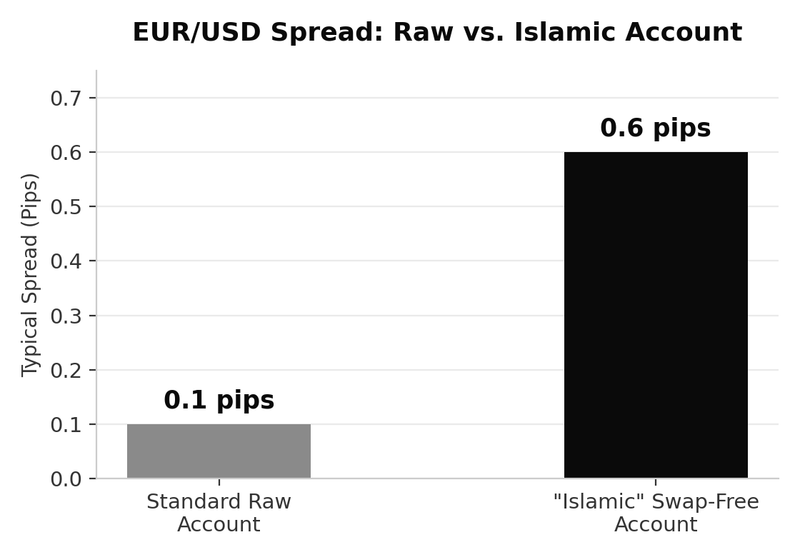
Typical EUR/USD spread, standard vs. Islamic account
Source: FXNX, Islamic Account Requirements
On a single standard lot trade, that difference can turn a $10 spread cost into an $18 one, a cost that compounds across dozens or hundreds of trades over a year.
Source: FXNX, Forex Halal Swap-Free Accounts Demystified
What Should You Actually Check Before Opening One?
Never take the label 'swap-free' or 'Islamic account' at face value. Compare the same broker's standard and Islamic spreads directly, ask specifically whether an administrative fee applies after a grace period and how it is calculated, and confirm whether the swap-free status actually extends to every instrument you plan to trade, since some brokers only remove it from major currency pairs while still applying full swap charges on indices, metals, or stocks. The genuinely compliant version of forex trading exists, spot contracts, immediate settlement, no interest in any form, but finding an account that actually delivers it takes real due diligence, not just a checkbox at signup.
//
Be first. Be Able.
Join the waitlist now. UAE, Saudi Arabia, and Qatar launch first. Early users get priority onboarding, locked-in yield rates, and zero fees for the first year.