How Did Islamic Banking Go From a Small Egyptian Experiment to a $3 Trillion Industry?
Islamic banking's entire history fits inside one working lifetime: from a quiet 1963 experiment in Mit Ghamr, Egypt to a $3 trillion industry across 80+ countries. Here's how it happened.

Modern Islamic banking is younger than most people assume, younger than commercial aviation, younger than the credit card. Its entire history fits inside a single working lifetime, and tracing it explains a lot about why the industry looks the way it does today.
Where Did Islamic Banking Actually Begin?
The first modern experiment opened in 1963, in the small Egyptian town of Mit Ghamr, where economist Ahmad El Naggar built a profit sharing savings bank modeled loosely on German cooperative savings institutions. It ran quietly, without emphasizing its Islamic identity too loudly given the political climate at the time, and by the time it wound down in 1967, it had grown into nine separate banks and proven the concept worked at scale.
Source: AIMS Education, History of Islamic Banking
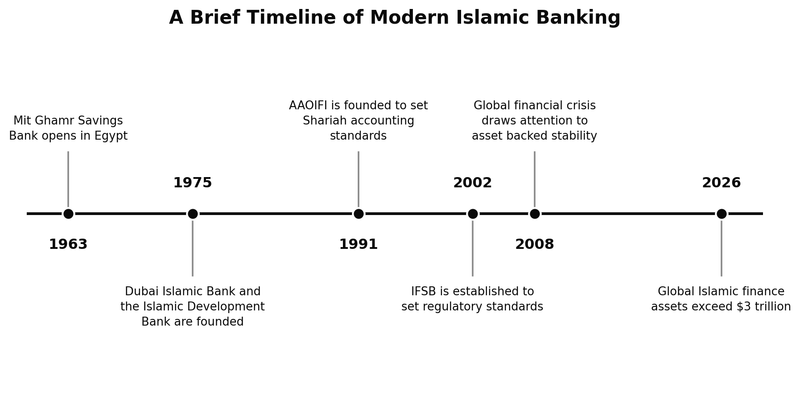
Key milestones in the history of modern Islamic banking
When Did Islamic Banking Become a Real Commercial Industry?
Dubai Islamic Bank, founded in 1975, became the first privately owned commercial bank to operate entirely under Islamic principles, the same year the Islamic Development Bank was established in Jeddah.
Source: Wikipedia, 1975 in the United Arab Emirates
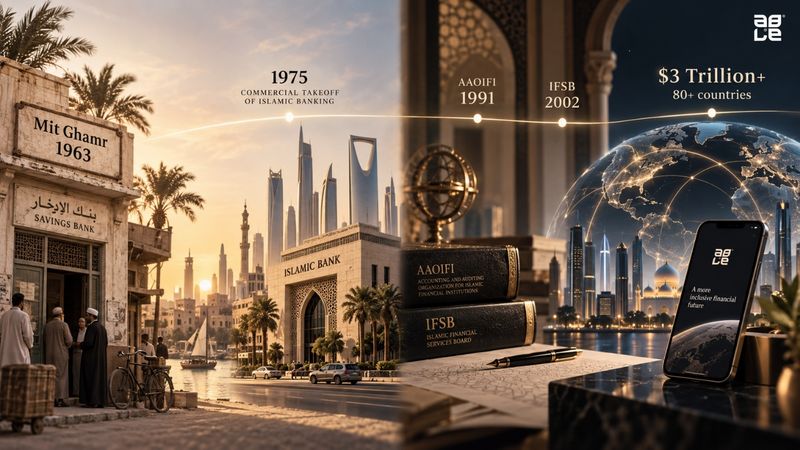
That single year marks the real transition from experiment to industry. Within two years, similar Islamic banks had opened in Kuwait, Egypt, and Sudan, and the oil boom of the 1970s gave the sector the capital base it needed to scale quickly across the Gulf.
Who Actually Set the Rules the Industry Follows Today?
For its first three decades, Islamic banking grew without a shared rulebook, each institution setting its own Shariah standards. That changed with AAOIFI, founded in Bahrain in 1991 to standardize accounting and Shariah compliance, followed by the IFSB, established in Kuala Lumpur in 2002 to set prudential and regulatory standards for the institutions supervising Islamic banks. Together, they turned a patchwork of individually interpreted practices into something closer to a coherent global industry.
Source: HalalWallet, IFSB Definition
Why Did 2008 Matter for Islamic Banking's Reputation?
The global financial crisis did more for Islamic banking's credibility than any marketing campaign could have. Because Islamic finance ties every contract to a real, tangible asset or genuine trade rather than leveraged debt instruments, the sector avoided much of the direct contagion that hit conventional banks in 2008. That contrast prompted a wave of new interest from regulators and investors who had never previously considered Islamic finance as a serious institutional alternative.
How Big Has the Industry Actually Become?
Sixty three years after Mit Ghamr opened its doors, global Islamic banking assets exceed $3 trillion, growing at 10% to 15% a year across more than 80 countries. What started as a small, quiet experiment run under the radar in one Egyptian town is now a core pillar of financial infrastructure across the Gulf, Southeast Asia, and increasingly, everywhere Muslim communities live. Able is being built as the next chapter of that same trajectory, not a replacement for the history but a continuation of it, adapted for a generation that expects that history delivered through a phone rather than a branch.
//
early Access — UAE first
Be first. Be Able.
Join the waitlist now. UAE, Saudi Arabia, and Qatar launch first. Early users get priority onboarding, locked-in yield rates, and zero fees for the first year.